My Story
How I became the
Architect of Possibilities
Introduction
I'm Leanne — a strategist, advisor, and founder of Vzir, a practice dedicated to helping leaders and organisations work well in complexity.
My work is grounded in a simple belief:
In systems that are complex, unequal, and deeply interconnected, our thinking and leadership must be just as sophisticated.
This is the story of how I came to do that work.
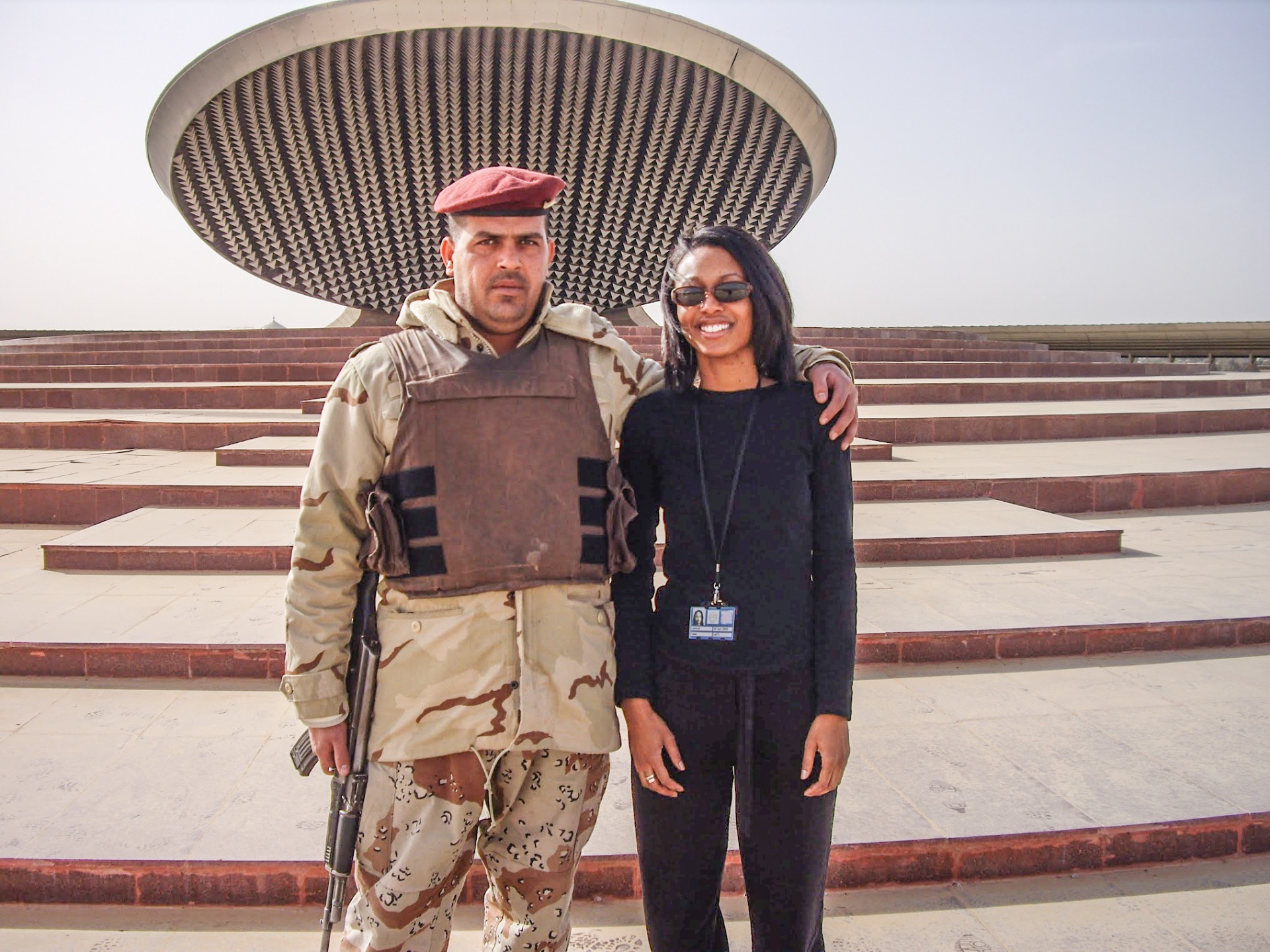
Baghdad — on secondment
Chapter — Origins
From a Midlands Playground to Global Systems
The Architect of Possibilities isn't a title I came up with in a branding workshop. It's the thread that runs through my life — from a Midlands playground to European institutions, conflict zones, and corporate boardrooms.
I grew up in a rundown inner-city neighbourhood in the Midlands, where expectations were low and futures felt prescribed. My grandparents had left beautiful Caribbean islands for an industrial city, trading sunshine and community for smog and opportunity. Even as a child, I understood I was the flag bearer of that sacrifice.
My first act of change happened in the school playground. Children were getting hurt on hard tarmac, and the solution offered was to shrink their world — less play, less risk. But after experiencing a safer surface elsewhere, I saw the problem differently.
The pattern
- 01 See differently — refuse to accept that "this is just how it is"
- 02 Research deeply — get curious about how things work and what else is possible
- 03 Synthesise & persuade — listen, build a credible case, and bring others with you
At seven, that meant organising a petition and persuading my headteacher to change the playground. The result was a safer, more expansive space — and a quiet blueprint for how I would later operate in far more complex systems.
Chapter — Re-Architecture
Learning to Re-Architect What's Possible
At senior school, I entered another space not built with someone like me in mind. I saw how narrative and access shaped who felt they belonged, so I founded a school newspaper to create a platform for voice and visibility.
Again, when the system wasn't working, I didn't just adapt to it — I started re-architecting it.
That instinct followed me into Brussels, into policy and high-profile roles, where I learned how institutions work, and how easily people can be excluded from them.
I also learned the limits of "fitting in." Wearing the right clothes or saying the right things didn't change who I was, or the barriers that existed. That realisation changed everything.
In Manchester, working in strategy and economic development, I learned to connect policy ambition with financial reality — understanding how decisions on funding and investment shape what is actually possible.
Each role, each barrier, sharpened my ability to read context, see patterns, and design credible paths forward.
Chapter — Complexity
Operating in Complexity: From Baghdad to Dubai
Then came Iraq.
A secondment focused on economic development and trade in one of the world's most complex environments. On paper, I wasn't the obvious fit. In practice, I was exactly what was needed.
In Baghdad, my lack of traditional privilege became a strength. I led with curiosity, built relationships, and navigated a landscape where politics, security, infrastructure, and livelihoods were deeply interconnected.
I learned to operate in constant uncertainty, to distinguish noise from real risk, and to make decisions under pressure.
That experience reshaped my understanding of impact.
Later, in Dubai, I worked on major international projects and helped grow a consultancy operating in high-risk environments. I stepped into leadership early, delivered complex programmes, and built networks that brought together governments, businesses, and experts to unlock opportunities that wouldn't otherwise exist.
The thread
What I Do Now
Vzir, and re-architecting leadership.
Across every stage — from playground to policy to post-conflict environments — the pattern has been consistent. I haven't simply worked within systems that weren't built for me; I've found ways to re-architect what's possible inside them.
Today, I channel everything I've learned into Vzir — the organisation I founded to use data, analytics, and strategy to innovate social, economic, and environmental impact.
If the world we operate in is structurally multicultural, unequal, and interdependent, then our leadership, decisions, and business models must be designed to match that complexity — not flatten it.
On one side
Data, analytics, and rigorous context-reading.
On the other
Bold, credible re-design of how organisations create value, manage risk, and show up in the world.
What I Bring
To leaders and boards.
I step into situations where people say, "This is just how it is," and I challenge that thinking.
I help uncover what's really going on, bring clarity to complexity, and support better, braver decisions — grounded in reality and driven by impact.
Whether I'm advising a board, working with an executive team, or acting as a thinking partner to a leader, I'm doing the same work I started as a child:
- Seeing more of the system.
- Finding room to move.
- And building the confidence to act.
That is what it means, for me, to be the Architect of Possibilities.